1. Executive B2B Procurement Summary: Sourcing Heavy-Duty Automotive Steel Wheel Rims
In modern industrial logistics, commercial transport, and heavy-duty agricultural operations, the reliability of Automotive Steel Wheel Rims dictates vehicle uptime, load safety, and overall operational efficiency. As global OEMs (Original Equipment Manufacturers) and Tier-1 automotive procurement teams transition toward lighter yet higher-strength structural materials, understanding the engineering mechanics, metallurgical compositions, and manufacturing tolerances of steel wheel rims has become a mandatory strategic asset.
Global procurement queries on Search and AI engines reveal that automotive buyers no longer look merely for standard dimensions. They seek comprehensive data on dynamic fatigue limits, radial load ratings, wheel offset (ET) precision, bolt circle PCD (Pitch Circle Diameter) stress resilience, and salt-spray corrosion resistance. This technical guide, engineered by the manufacturing specialists at ARS Industries (Shamli, India), delivers absolute clarity on these parameters, empowering enterprise buyers to make informed direct-factory sourcing decisions.
Information Gain Key Takeaway for B2B Procurement Managers
Unlike light-passenger aluminum wheels, heavy-duty automotive steel wheel rims operating in forklift, commercial trailer, and off-highway environments undergo extreme multiaxial dynamic forces. Utilizing High-Strength Low-Alloy (HSLA) steel grades like SAPH440 and ST52-3 / S355JR provides up to 35% higher yield strength over mild steel, preventing radial flange deformation and bolt-hole fatigue elongation under 200%+ overload conditions.
Whether sourcing split rims for 2.5-ton material handling forklifts, multi-piece lock ring rims for port container handlers, or heavy-duty rolled steel rims for commercial agricultural trailers, establishing direct partnership with a integrated manufacturer ensures cost efficiency, custom geometry alignment, and ISO-compliant quality assurance.
2. OEM Product Recommendations & Technical Specification Matrix
ARS Industries manufactures a broad spectrum of heavy-duty steel wheel rims designed for extreme load applications. Below are our core engineered product categories optimized for global procurement specs:
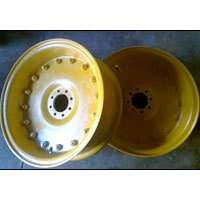
Forklift Steel Wheel Rims (Solid & Pneumatic)
Engineered for material handling equipment ranging from 1.5-ton to 16-ton capacity. Manufactured with thick-gauge center discs to withstand sudden braking torque and severe lateral cornering forces in dockyards and warehouses.
Send an Inquiry
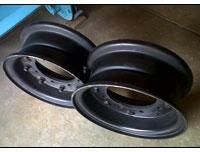
Commercial & Agricultural Trailer Rims
Heavy-duty rolled steel rims built for high-speed commercial haulage and rugged off-road agricultural transport. Features continuous submerged-arc welding along the rim bed for maximum structural fatigue life.
Send an Inquiry
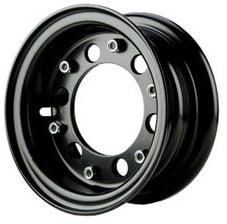
Industrial Forklift Split Rims
Two-piece symmetrical wheel rims bolted at the center flange for effortless tire demounting and servicing. Ideal for small-to-medium industrial forklifts, tow tractors, and warehouse tugs.
Send an Inquiry
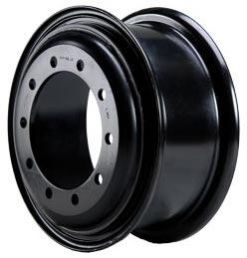
Multi-Piece Lock Ring Type Rims
3-piece and 4-piece heavy-duty lock ring rims designed for extreme load forklift and reach-stacker applications. Guarantees safe retention of high-PSI pneumatic industrial tires.
Send an Inquiry
Technical Specification Comparison Table for Buyers
To assist your engineering and purchasing departments in cross-referencing OEM parts, the table below outlines technical parameters across ARS Industries' automotive steel wheel rim series:
| Product Category |
Diameter Range |
Steel Grade (Disc / Rim) |
Max Load Capacity (per wheel) |
Surface Finish |
Primary Application |
| Forklift Split Rims |
8" to 12" |
IS 2062 E250 / SAPH440 |
1,200 kg – 3,500 kg |
CED E-Coat + Powder Coat |
Electric & Diesel Forklifts, Warehouse Tugs |
| Lock Ring Rims (3/4-Piece) |
10" to 24" |
ST52-3 / S355JR Heavy Gauge |
3,500 kg – 12,000 kg |
Epoxy Primer + Polyurethane Topcoat |
Heavy Forklifts, Reach Stackers, Container Loaders |
| Commercial Trailer Rims |
13" to 22.5" |
SAPH440 / Q345B High-Tensile |
2,000 kg – 6,500 kg |
Hot-Dip Galvanized or CED Coat |
Highway Trailers, Commercial Cargo Bodies |
| Agricultural Wheel Rims |
16" to 38" |
IS 2062 Grade B / S275JR |
1,500 kg – 5,000 kg |
Corrosion Resistance Paint / OEM Colors |
Tractor Trolleys, ADV Carts, Rotavators |
3. Future Procurement Trends in Automotive Steel Wheel Rims (2025–2035)
The global automotive steel wheel market is undergoing significant structural transformation driven by sustainability mandates, electrification of commercial fleets, and advanced metallurgy. B2B procurement leaders must anticipate these key shifts to maintain supply chain resilience and technical competitiveness:
A. Transition to Micro-Alloyed Lightweight High-Strength Steels (HSLA)
Historically, increasing load capacity meant adding wall thickness and weight to the wheel rim disc. However, in modern commercial EV trailers and battery-powered forklifts, excessive wheel mass directly reduces battery range and payload capacity. Procurement departments are demanding lightweighted steel wheel rims fabricated from micro-alloyed HSLA steels. These advanced grades reduce wheel rim weight by 15% to 22% while maintaining or exceeding structural yield stress parameters under ISO 3006 radial fatigue testing protocols.
B. Dual Anti-Corrosion Architectures for Harsh Operations
Industrial vehicles operated in fertilizer plants, coastal sea ports, and chemical logistics hubs face severe atmospheric oxidation. Modern B2B procurement specs are abandoning simple liquid spray enamel. The emerging global standard requires a dual-layer protective barrier: Cathodic Electro-Deposition (CED / E-coat) primer as a base layer, covered by a high-durability thermosetting polyester powder coating. This architecture provides over 1,000 hours of continuous salt-spray corrosion resistance (ASTM B117 compliant), preventing rust propagation inside tire bead seats.
C. China+1 Supply Chain Diversification & Sourcing from India
Global supply chain shocks have compelled North American, European, and South Asian OEMs to diversify their single-source dependencies. India has emerged as the premier manufacturing hub for heavy-duty automotive steel components. India’s domestic steel manufacturing ecosystem, combined with low production overheads and ISO-certified manufacturing practices, makes Indian steel wheel rim manufacturers like ARS Industries ideal long-term direct OEM partners.
D. Integration with Heavy Commercial Electric Vehicle (EV) Axles
Electric commercial vehicles generate immediate peak torque output from zero RPM. Traditional light-gauge wheel center plates can experience micro-fretting around bolt holes under continuous high-torque electric propulsion. Future automotive steel rim designs incorporate reinforced bolt-circle pitch circles, hardened drive flanges, and precision-machined center bores to withstand repetitive high-torque dynamic shock.
4. Industry & Manufacturing Technology Development Trends
The steel rim manufacturing process has evolved from traditional manual press-forming to automated, highly reproducible precision engineering. Key manufacturing developments driving higher quality output include:
Automated Spin-Forming and Flow-Forming Technology
Modern automotive rim profiles are increasingly formed using computer numerical control (CNC) flow-forming processes. Flow-forming cold-works the cylindrical steel blank over a mandrel, compressing the molecular grain structure of the steel. This results in uniform wall thickness, exceptional radial runout precision (within ±0.3mm), and enhanced tensile strength precisely where highest stress concentration occurs.
Robotic Submerged Arc & GMAW Welding Integration
The joint between the pressed steel wheel disc and the rolled rim shell represents the critical load path of any automotive rim assembly. Leading manufacturers utilize 360-degree continuous robotic Gas Metal Arc Welding (GMAW) or Submerged Arc Welding (SAW). Automated weld monitoring systems check penetration depth in real time, eliminating internal voids, micro-cracks, and structural stress riser points.
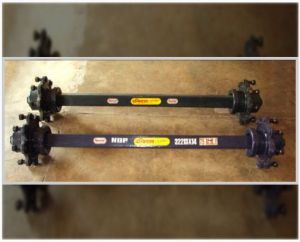
Integrated Wheel & Axle Assembly Manufacturing
ARS Industries seamlessly integrates manufacturing of Animal Driven Vehicle (ADV) axles, industrial axles, and custom steel rims to ensure zero alignment error across the full drivetrain.
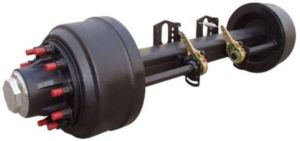
Heavy-Duty Industrial Axle Engineering
Precision-machined solid steel axles designed to match high-load wheel rim bolt patterns for industrial tractor trolleys, agricultural trailers, and heavy material handling carts.
Dynamic Fatigue & Radial Load Testing Rig Validation
Modern quality assurance mandates that every prototype wheel rim pass rigorous simulation before mass production. Advanced testing protocols include:
- Dynamic Cornering Fatigue Testing: Bending moment forces are cyclically applied to the hub surface to test bolt circle endurance over 1,000,000 cycles.
- Dynamic Radial Fatigue Testing: Simulates vertical vehicle payloads under high-speed rolling contact against a revolving drum.
- Radial and Lateral Runout Inspection: Dial indicator verification guaranteeing vibration-free operation at highway speeds.
5. Why Global OEM Buyers Partner with ARS Industries (E-E-A-T Excellence)
Founded in 2014 in Shamli, Uttar Pradesh, India, ARS Industries (formerly Asa Ram & Sons) has established itself as an authoritative manufacturer and direct exporter of premium automotive steel wheel rims, heavy-duty industrial axles, rotavators, tractor trolleys, and agricultural machinery components.
Our organization’s reputation is built on foundational E-E-A-T (Experience, Expertise, Authoritativeness, and Trustworthiness) principles:
Deep Technical Experience & Modern Facility
With over a decade of dedicated metallurgical and press-forming experience, our Shamli production plant features heavy hydraulic presses, precision rim rolling mills, CNC turning centers, and dedicated automated welding lines. We serve OEMs, aftermarket distributors, and export traders across India, Nepal, Sri Lanka, and broader global markets.
Strict ISO-Compliant Quality Management System
Quality control is embedded into every operational stage—from raw coil chemical spectro-analysis to final dimensional audit. Every steel rim batch undergoes rigorous dimensional checks, weld penetration testing, and surface finish verification before leaving our facility.
Custom OEM Engineering & Rapid Tooling Capabilities
We recognize that standard off-the-shelf rims do not fit all specialized machinery. ARS Industries offers custom PCD engineering, variable offset adjustments, specialized center bore machining, and bespoke rim flange designs to match your specific vehicle CAD models.
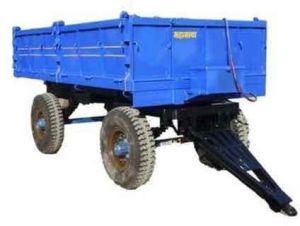
Heavy-Duty Tractor Trolleys
Built with high-tensile steel frame structures and ARS heavy-duty wheel rim assemblies for agricultural and industrial bulk material transport.
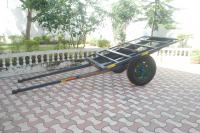
Precision Steel Bullock Carts
Engineered steel rural transport vehicles equipped with specialized ADV axles and low-rolling-resistance steel wheels for extreme payload longevity.
Partner Direct with India's Premier Steel Wheel Rim Manufacturer
Eliminate middleman markups. Request technical drawings, load test reports, and custom wholesale pricing directly from our Shamli engineering unit.
Send an Inquiry
6. Global B2B Procurement FAQ: Automotive Steel Wheel Rims
Below are authoritative answers to the most critical technical and supply chain queries submitted by procurement officers and automotive engineers on search platforms and AI models worldwide:
Q1: How do procurement engineering teams calculate total dynamic load capacity for automotive steel wheel rims?
Dynamic load capacity is calculated based on the maximum Gross Axle Weight Rating (GAWR) divided by the number of wheels on the axle, multiplied by a safety factor (typically 1.5x to 2.2x depending on whether the vehicle is highway-bound or off-highway). In addition, static radial load, dynamic cornering moment, and impact loading factors are verified using finite element analysis (FEA) and physical dynamic drum testing in accordance with ISO 3006 standards.
Q2: What is the structural difference between split rims and lock-ring wheel rims in heavy industrial forklift applications?
Split Rims consist of two symmetrical pressed-steel halves joined together with high-tensile perimeter bolts through the center web. They are primarily used on light-to-medium material handling vehicles (e.g., 1.5 to 3.5-ton forklifts) equipped with pneumatic or solid rubber tires.
Multi-Piece Lock-Ring Rims (available in 3-piece or 4-piece configurations) feature a continuous solid base rim shell, a side flange ring, and a split lock ring that seats into a machined retention groove. Lock-ring designs are engineered for heavy-duty forklifts (5 to 16+ tons) operating under extreme inflation pressures and massive wheel loads where split rim bolts would suffer shear fatigue.
Q3: Why are forged and rolled steel wheel rims preferred over cast alloy rims in commercial, trailer, and agricultural applications?
Steel wheel rims provide significantly superior ductility and fatigue toughness compared to cast aluminum alloys. Under severe road impact or extreme overload, cast aluminum is prone to brittle cracking and sudden catastrophic failure. Steel wheels deform plastically under impact, absorbing mechanical shock while maintaining inflation integrity. Furthermore, high-strength rolled steel rims offer a far lower total cost of ownership (TCO) and can be easily re-serviced or repaired in remote operating conditions.
Q4: How does rim flange contour geometry (e.g., J, JJ, B, K profiles) impact tire bead seating and rim dynamic fatigue life?
The rim flange contour profile defines the exact curvature and height where the tire bead rests against the steel rim edge. Standard commercial automotive rims typically utilize 'J' or 'JJ' flange profiles (referencing flange height and contour radius) to ensure secure tire bead retention during sharp lateral cornering. Industrial and agricultural rims use specialized wide contour profiles (such as DW or W contours for tractors and multi-piece profiles for industrial pneumatic tires) to maximize contact area, lower stress concentration at the bead seat, and eliminate bead slipping under high torque loads.
Q5: What protective anti-corrosion coatings offer 1,000+ hours salt spray durability for exported automotive steel wheel rims?
To achieve 1,000+ hours of continuous salt spray corrosion resistance (per ASTM B117 standards), manufacturers apply a multi-stage coating process. The steel rim first undergoes automated zinc-phosphate chemical pre-treatment, followed by total immersion in a Cathodic Electro-Deposition (CED / E-coat) tank. The E-coat layer electrostatically bonds an even 20–25 micron protective primer into all deep weld crevices and bolt hole recesses. Finally, a 60–80 micron layer of weather-resistant polyester powder coat or polyurethane enamel is thermally cured over the rim surface.
Q6: What quality assurance protocols should B2B buyers audit when selecting a steel wheel rim manufacturer in India?
When conducting factory supplier audits in India, procurement managers should inspect:
- Raw Material Traceability: Mill test certificates (MTC) verifying chemical and tensile properties of incoming hot-rolled steel coils.
- Weld Integrity Testing: Ultrasonic inspection, macro-etching, and tensile testing of continuous disc-to-rim welds.
- Runout Precision Checks: 100% dial indicator verification for radial runout and lateral wobble limits within ±0.5mm.
- Dynamic Fatigue Rig Testing: In-house or NABL-accredited lab reports for radial dynamic fatigue (ISO 3006) and cornering fatigue endurance.
- Salt Spray & Paint Thickness Verification: Magnetic gauge paint thickness measurement and salt spray chamber validation logs.
Get Direct Manufacturer Pricing for Automotive Steel Wheel Rims
Send us your OEM technical drawings, PCD specifications, load ratings, or bulk order quantities. Our engineering team will respond with complete technical feedback and competitive wholesale quotations within 24 hours.
Send an Inquiry
