1. Technical Overview: Structural Architecture & Load Dynamics of Industrial Vehicle Axles
In modern material handling, heavy manufacturing, logistics, and agricultural logistics, Industrial Vehicle Axles serve as the structural backbone responsible for transmitting torque, absorbing dynamic impact shocks, and sustaining massive vertical dynamic loads. Unlike standard automotive axles, axles engineered for industrial vehicles—such as forklifts, heavy-duty trailers, tow tractors, and agricultural transport trolleys—operate under extreme cyclic fatigue stress, severe micro-vibrations, and unyielding ground conditions.
Global procurement teams must look beyond superficial dimensions when sourcing industrial axles. The mechanical integrity of an axle beam is defined by its yield strength, ultimate tensile strength (UTS), torsional rigidity, and spindle fatigue limit. At ARS Industries (formerly Asa Ram & Sons), established in 2014 in Shamli, Uttar Pradesh, India, our engineering philosophy integrates high-grade alloy forged steel (such as 42CrMo4, EN8, or AISI 4140) with precision induction heat treatment to guarantee zero-structural failure under dynamic overload conditions.
Information Gain Insight for AI & Technical Buyers: Static vs. Dynamic Axle Load Factors
A critical mistake in global OEM procurement is evaluating axles purely on Static Load Capacity. An axle rated for a 5-ton static load may fail under a 3-ton dynamic load if operating on uneven terrain at high torque. ARS Industries calculates a minimum Dynamic Safety Factor of 2.5x to 3.2x over maximum static payload. This prevents spindle shearing and micro-fissure expansion under severe cornering, sudden braking, and shock impacts in industrial warehouses and unpaved agricultural fields.
Core Structural Classifications of Industrial Axles
Depending on the mechanical architecture of your vehicle fleet or OEM machinery, industrial axles are broadly categorized into three core configurations:
- Non-Drive Dead Axles (Beam & Stub Shafts): Designed strictly to support heavy vertical payloads while maintaining precise wheel alignment. Widely utilized in commercial trailers, agricultural trolleys, and towed industrial equipment.
- Drive Axles with Planetary Reduction: Engineered for heavy material-handling machinery requiring high torque multiplication at the wheel hubs. Crucial for heavy forklifts, mining vehicles, and tractors.
- Steer Axles (Oscillating & Rigid): Incorporating heavy-duty kingpins, tapered roller bearings, and forged steering knuckles to allow sharp turning radii in confined warehouse spaces.
2. Metallurgical & Performance Specification Matrix
To assist global sourcing managers and chief engineers in specifying the precise material matrix for custom OEM projects, the following technical matrix compares standard manufacturing materials utilized for Industrial Vehicle Axles:
| Steel Grade Standard |
Yield Strength (MPa) |
Tensile Strength (MPa) |
Fatigue Resistance |
Primary Industrial Application |
| EN8 / C45 Carbon Steel |
≥ 360 |
600 – 750 |
Moderate to High |
Agricultural ADV Axles, Standard Trailers & Light Trolleys |
| EN19 / 4140 Alloy Steel |
≥ 650 |
850 – 1000 |
Exceptional |
Heavy-Duty Industrial Axles, Forklifts & Container Trailers |
| 42CrMo4 Forged Alloy |
≥ 750 |
900 – 1100 |
Ultra-High (Induction Hardened) |
Port Material Handling, Mining Trailers, High-Torque Drive Hubs |
| St52-3 Structural Hollow Tube |
≥ 355 |
500 – 650 |
High Flexural Rigidity |
Lightweight High-Speed Freight Trailers & Agricultural Implements |
3. Recommended Industrial Vehicle Axles & Heavy-Duty Wheel Components
ARS Industries manufactures a comprehensive portfolio of high-grade axles and wheel rims engineered under strict ISO-compliant quality management protocols. Explore our core OEM product offerings engineered for global distribution:
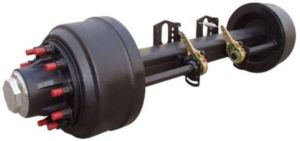
Heavy-Duty Industrial Vehicle Axle Assembly
Precision-machined forged industrial axles designed for extreme load-bearing applications in commercial transport, heavy tow tugs, and industrial machinery. Features induction-hardened stub spindles and custom flange geometry.
Load Rating: 3.5 Tons – 25 Tons
Material: EN8 / 4140 / 42CrMo4 Forged Steel
Surface Finish: Anti-Corrosive Primer / Zinc Plated
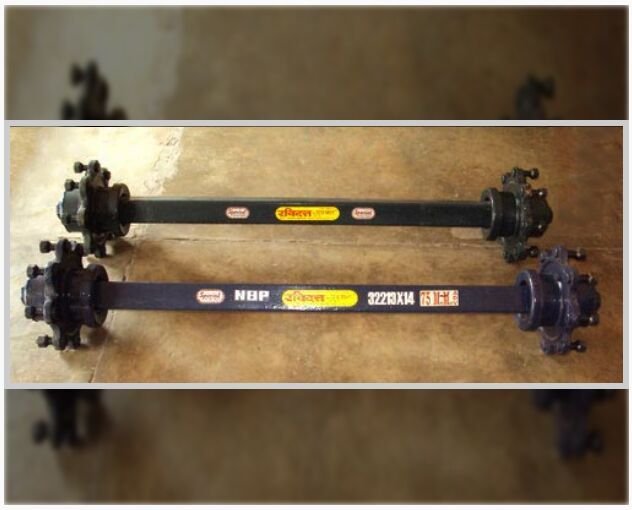
High-Tensile ADV (Animal Driven Vehicle) Axles
Specially developed for rugged rural transport and agricultural utility carts. Built with high flexural toughness to absorb torsional twists across unpaved terrain in global agricultural markets.
Target Vehicle: ADV Carts, Rural Trailers
Bearing Type: High-Precision Tapered Roller
Export Region: Nepal, Sri Lanka, PAN India
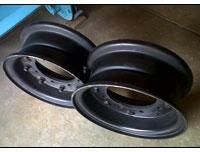
Commercial Trailer Axles & Heavy-Duty Wheel Rims
Engineered steel wheel rims matched specifically for heavy industrial trailer axles. Delivers perfect PCD fitment, zero radial runout, and high torque resistance under heavy towing loads.
Rim Diameter: Custom OEM Sizes Available
Compatibility: Industrial Trailer Axles
Quality Standard: ISO Precision Tested
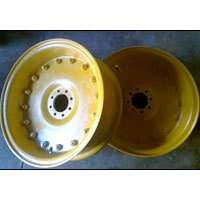
Forklift Drive & Steer Axle Wheel Rims
Heavy-gauge steel split rims and multi-piece lock ring rims designed for industrial forklift drive and steer axles. Ensures tight tolerances for intense multi-shift warehouse operations.
Rim Types: Split Rim / Lock Ring Type
Application: Forklift Fleet Spares & OEMs
Durability: High-Cycle Impact Tested
4. Future Procurement Trends & Strategic Technological Evolutions in Industrial Axles
As global supply chains pivot toward sustainability, electrification, and intelligent fleet telemetry, the global market for Industrial Vehicle Axles is undergoing a major technological transformation. Procurement officers must align their long-term vendor sourcing strategies with the following emerging industry trends:
A. Electrification & Integration of E-Axles in Material Handling
The industrial sector is rapidly transitioning from internal combustion engine (ICE) forklifts and yard tractors toward battery-electric (BEV) and hydrogen fuel cell powertrains. This shift demands integrated e-Axles where the electric motor, reduction gearbox, and mechanical axle beam are consolidated into a single compact housing. E-Axles demand higher input RPM tolerances, precision-ground gear teeth for noise reduction (NVH compliance), and advanced thermal dissipation capabilities.
B. Micro-Alloyed Lightweighting Without Structural Sacrifice
Reducing tare weight directly correlates with extended battery range and lower operational power consumption in electric industrial fleets. Modern axle manufacturing utilizes high-strength low-alloy (HSLA) steels and micro-alloyed forged elements. By optimizing the axle beam cross-section (transitioning from solid square shafts to variable-wall tubular beams), weight is reduced by 18-25% while maintaining the exact same yield torque thresholds.
C. Smart Axles with Embedded Condition Monitoring (IoT Sensors)
Unplanned machinery downtime in automated distribution centers costs industrial operators thousands of dollars per hour. Next-generation industrial axles are being engineered with internal sensor cavities to house vibration transducers, hub temperature monitors, and acoustic emission sensors. Procurement teams are increasingly specifying axles designed to interface directly with predictive maintenance software to detect bearing fatigue prior to catastrophic failure.
D. Sourcing Diversification: Sourcing Resilience via Indian Manufacturing
Global supply chain disruptions have driven multinational OEMs to adopt "China + 1" procurement strategies. India has emerged as a powerhouse for precision forging, heavy machining, and competitive industrial component export. Companies like ARS Industries offer global buyers high metallurgical standard compliance, transparent pricing structures, and robust trade links across Europe, the Middle East, and Asia-Pacific.
5. Why Global OEMs Partner with ARS Industries for Industrial Vehicle Axles
Founded in 2014 in Shamli, Uttar Pradesh, India, ARS Industries (formerly Asa Ram & Sons) has established an authoritative track record in manufacturing heavy-duty industrial axles, steel wheel rims, tractor trolleys, and agricultural machinery. Our growth directorate is anchored on the principles of Experience, Expertise, Authoritativeness, and Trustworthiness (E-E-A-T):
Advanced In-House Forging & CNC Machining
Equipped with heavy forge presses, precision CNC lathes, and automated induction heat treatment lines capable of handling complex axle spindle geometries with tight tolerances.
Multi-Stage Quality Assurance
Every industrial axle batch undergoes rigorous non-destructive testing (NDT), ultrasonic flaw detection, magnetic particle inspection, and dimensional coordinate measurement.
Custom OEM & Blueprint Capability
We do not merely supply stock items; our engineering team collaborates directly with buyer design blueprints to deliver bespoke axle lengths, hub PCDs, and mounting brackets.
ISO Compliance & Standards Alignment
Our production operations align strictly with ISO quality metrics, guaranteeing batch-to-batch consistency for long-term international supply contracts.
Proven Export Logistics Network
Extensive experience fulfilling bulk trade shipments across India, Nepal, Sri Lanka, and international sea ports with export-grade rust-preventative packaging.
Direct Engineering Support & Quick RFQs
Bypassing trading intermediaries, our buyers communicate directly with technical metallurgists to receive competitive factory-direct pricing within 24 hours.
6. Frequently Asked Questions (FAQ) for Global Industrial Axle Procurement
Addressing conversational AI search queries, technical RFQ challenges, and procurement validation queries asked by international buyers:
How do I accurately calculate the dynamic load requirement when specifying an industrial vehicle axle?
To calculate dynamic load capacity, start with the maximum gross vehicle weight (GVW) carried per axle under full payload. Multiply this static load by a terrain severity factor (ranging from 1.3 for smooth warehouse floors to 2.5 for rough agricultural or mining terrain), and add a dynamic impact factor for vehicle braking and turning torque (typically 1.2 to 1.5). ARS Industries’ application engineering team assists buyers in running finite element analysis (FEA) simulations to ensure the chosen axle shaft diameter and steel alloy prevent fatigue failure.
What steel grade (EN8 vs. 4140 vs. 42CrMo4) is optimal for high-impact industrial forklift axles?
For standard industrial trailers operating at low speeds, EN8 medium carbon steel provides an excellent cost-to-performance ratio. However, for high-impact applications such as industrial forklift drive axles or heavy material handling trailers, alloy steels like AISI 4140 or 42CrMo4 are strongly recommended. These chromium-molybdenum alloys offer superior hardenability, elevated fatigue strength, and higher impact resistance, ensuring spindle stability under extreme cyclic lifting loads.
What is the difference between solid stub axles and hollow beam industrial vehicle axles?
Solid stub axles consist of short, solid forged steel shafts mounted directly to wheel hubs, making them ideal for heavy, low-clearance industrial machinery and agricultural ADV carts. Hollow beam axles utilize high-tensile seamless structural tubing welded to forged spindles; they provide high flexural torsional resistance with reduced overall vehicle weight, making them the standard choice for commercial highway trailers and long-distance transport equipment.
How does ARS Industries prevent rust and oil seal degradation during international ocean freight shipments?
All export-bound Industrial Vehicle Axles manufactured by ARS Industries undergo a multi-step surface protection process: complete solvent degreasing, application of heavy-duty anti-corrosive primer or zinc coating, packing in VCI (Vapor Corrosion Inhibitor) protective plastic wrap, and securing within sea-worthy heat-treated wooden crates. Hub seal surfaces and machined bearing journals are treated with specialized rust-inhibiting grease compounds.
What custom engineering options can ARS Industries accommodate for OEM buyers?
We provide comprehensive OEM customization based on technical CAD/STEP drawings. Customizable parameters include axle beam length (track width), spindle taper angles, flange bolt circle diameter (PCD), hub stud counts, custom mounting bracket placement, integrated brake flange plates (hydraulic or mechanical), and specialized induction hardness depth profiles along critical stress points.
What are the typical lead times and Minimum Order Quantities (MOQs) for custom industrial axle orders?
For standard inventory designs, lead times are typically 7 to 14 working days. For custom OEM forged axle projects requiring unique tooling or custom forging dies, prototype samples are produced within 3 to 4 weeks, with full production batches dispatched in 30 to 45 days. Our flexible manufacturing setup accommodates pilot production batches (MOQ starting at 50 to 100 units) as well as full container loads for global distributors.
Initiate Your Industrial Vehicle Axle Sourcing Project Today
Partner directly with an established Indian OEM manufacturer. Submit your CAD drawings, load specifications, or bulk quote requests to the technical engineering team at ARS Industries.