
1. Technical Fundamentals & Beam Metallurgy of Commercial Trailer Axles
In global logistics, haulage, and heavy transportation, commercial trailer axles serve as the ultimate structural backbone connecting vehicle chassis frames to ground motion interfaces. Operating under demanding cyclic loads, shear forces, and severe environmental stresses, modern commercial trailer axles are engineered to ensure load distribution equity, tire wear optimization, and mechanical braking reliability.
When global original equipment manufacturers (OEMs) and transport fleet buyers source commercial trailer axles, evaluating structural beam metallurgy is paramount. The axle beam experiences complex stress states—primarily bending moments caused by payload weight and torsional moments induced during braking or cornering maneuvers.
Engineering Note: Beam Deflection & Dynamic Yield Strength
Axle beam survival relies on maintaining structural rigidity within elastic limits. Seamless high-strength low-alloy steel tubing (such as ST52, SAE 1045, or 20Mn2) undergoes precision induction heat treatment (quenching and tempering) to achieve yield strength ratings exceeding 650 MPa, ensuring minimum deflection under maximum rated Gross Axle Weight Ratings (GAWR).
Commercial trailer axle designs generally bifurcate into two core geometric profiles: round hollow tube profiles and square solid/hollow beam structures:
- Round Axle Beams: Highly effective at handling multi-directional torsional stresses. Round seamless steel tubes deliver uniform strength-to-weight ratios, making them the industry standard for long-haul highway semi-trailers.
- Square Axle Beams: Provide superior resistance against vertical bending moments. Preferred for off-road commercial trailers, agricultural dump trailers, and heavy industrial transport carts where ground clearances vary and severe vertical impact shocks occur frequently.
2. High-Performance Commercial Trailer Axles & Component Portfolio
ARS Industries (formerly Asa Ram & Sons) leverages over a decade of precision manufacturing capability at Shamli, Uttar Pradesh. Our facility produces ISO-compliant commercial trailer axles, industrial axles, ADV (Animal Driven Vehicle) axles, and high-tolerance steel wheel rims tailored for global OEMs and international traders.
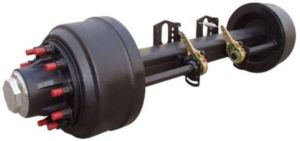
Heavy-Duty Industrial Commercial Axle
Forged with high-grade carbon steel spindles welded to heavy-wall seamless tubular beams. Ideal for heavy haulage trailers, container chassis, and specialized industrial transport equipment.
Inquire Now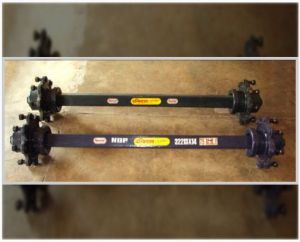
ADV & Agricultural Commercial Axles
Engineered specifically for extreme payload endurance in rural, agricultural, and mixed-terrain conditions across India, Nepal, and Sri Lanka. Exceptional fatigue resistance and zero-defect hub alignment.
Inquire Now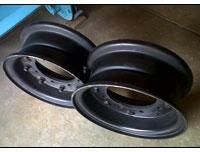
Commercial Heavy Duty Trailer Rims
Formed from cold-rolled structural steel to ensure perfect concentricity with trailer axle hubs. Available in single and dual-wheel configurations for highway semi-trailers.
Inquire Now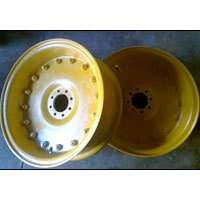
Forklift & Industrial Fleet Wheel Rims
Precision-engineered split and lock-ring wheel rims designed to complement heavy industrial steer and drive axles under high payload material handling operations.
Inquire NowTechnical Specification Comparison Table
To assist OEM procurement managers and fleet engineers in selecting the optimal commercial trailer axle configuration, the reference matrix below details standardized physical metrics across ARS product categories:
| Axle Type / Profile | Rated Capacity (GAWR) | Spindle Diameter | Beam Profile & Size | Brake Systems Supported | Target Market Application |
|---|---|---|---|---|---|
| Heavy Commercial Trailer Axle | 12,000 kg – 16,000 kg | Ø 88mm – 105mm | 150mm Round / Square Hollow | Pneumatic Drum / Disc Brake | Intermodal Freight, Flatbeds, Tankers |
| Medium Industrial Axle | 6,000 kg – 10,000 kg | Ø 70mm – 85mm | 120mm Round Tube | Hydraulic / Drum Brakes | Factory Trailers, Mining Carts |
| ADV / Agri Commercial Axle | 3,000 kg – 8,000 kg | Ø 50mm – 65mm | 80mm – 100mm Solid Square | Mechanical / Custom Hubs | Agricultural Trolleys, Rural Haulage |
| Custom OEM Drop Axle | 8,000 kg – 14,000 kg | Engineered to Spec | 4-Inch Drop Center Beam | Air Brake Systems | Low-Boy Heavy Haulers, Car Carriers |
3. Global Sourcing Trends in Commercial Trailer Axles (2025–2030)
As the international logistics sector undergoes rapid modernization, the global procurement landscape for commercial trailer axles is shifting toward localized, high-value manufacturing destinations. Buyers searching on AI search platforms consistently prioritize supply chain resilience, total cost of ownership (TCO), and advanced metallurgical consistency.
1. The "China+1" Diversification & India's Manufacturing Hub Expansion
Global supply chain managers are actively mitigating geopolitical risk by diversifying their axle procurement away from single-source markets. India has emerged as a premier global hub for precision automotive and trailer components. Indian manufacturers like ARS Industries combine cost-efficient raw material access with strict ISO quality assurance, offering European, Middle Eastern, and Asian buyers an ideal sourcing destination for heavy commercial trailer axles and wheel rims.
2. Integration of Smart Sensors & Telematics Compatibility
Future commercial trailer axles are no longer standalone mechanical assemblies. The modern fleet industry demands digital sensor integration natively built into axle spindles and hub caps. Real-time temperature monitoring for taper roller bearings, automated tire inflation systems (ATIS), and ABS wheel speed sensors are becoming mandatory specs. OEM axle manufacturers are modifying spindle geometry to include internal routing channels for sensor wiring harnesses.
3. Total Cost of Ownership (TCO) & Unitized Bearing Hubs
Fleet operators calculate purchasing decisions based on TCO per kilometer. Traditional trailer axles required routine manual repacking of bearing grease every 50,000 km. The industry is rapidly shifting toward pre-adjusted, sealed-for-life unitized hub bearings. These maintenance-free hub units eliminate field adjustment errors, minimize downtime, and dramatically cut labor costs for commercial transport operators.
Need Custom Engineered Commercial Trailer Axles for Your Fleet?
ARS Industries supplies global OEMs and distributors with precision-machined axle beams, hub units, and custom specs with guaranteed dimensional tolerances.
Inquire Now4. Key Technological Trends Driving Commercial Axle Manufacturing
Advances in structural engineering and manufacturing automation are redefining the operational lifecycle of commercial trailer axles. Key technological vectors include:
Weight Reduction via High-Strength Low-Alloy (HSLA) Steels
Reducing tare weight directly correlates with increased freight payload capacity and reduced carbon emissions. By replacing traditional thick-walled carbon steel tubes with Micro-Alloyed High-Strength Steels (containing trace amounts of Vanadium or Niobium), axle manufacturers can reduce beam wall thickness by up to 15% without sacrificing yield strength or fatigue life.
Automated Friction Welding & Ultrasonic NDT Inspection
The joint connecting the forged steel spindle to the tubular axle beam is the highest stress point on any commercial trailer axle. Advanced production facilities utilize automated Friction Welding (FRW) techniques. Friction welding produces a solid-state forged joint with zero porosity and superior fatigue strength compared to conventional manual arc welding. Every joint undergoes Ultrasonic Non-Destructive Testing (NDT) to guarantee internal weld integrity prior to machining.
Electrophoretic Coating (E-Coat) Surface Protection
Commercial trailers face harsh operating environments including road salt, moisture, and chemical exposure. Modern commercial trailer axles undergo multi-stage zinc phosphate pre-treatment followed by Cathodic Electrodeposition (E-coat) primers. This micro-thin, highly adherent finish delivers over 1,000 hours of salt spray corrosion resistance (ASTM B117 compliance), ensuring long service life without surface degradation.
5. Corporate Competence & Quality Standards at ARS Industries
Founded in 2014 in Shamli, Uttar Pradesh, ARS Industries (Asa Ram & Sons) has established itself as an authoritative manufacturer and exporter of heavy-duty industrial components. Our corporate strategy centers on strict adherence to international quality standards, rigorous quality control processes, and responsive OEM customization capabilities.
Our core enterprise advantages include:
- Integrated Metallurgical Testing: In-house chemical spectrometry, Brinell/Rockwell hardness testing, and tensile strength analysis ensure raw steel billets meet precise SAE/DIN grade requirements before entering the forging line.
- High-Precision CNC Machining: Axle spindles, hub seating surfaces, and brake flange mounts are turned on multi-axis CNC lathes to achieve tight dimensional tolerances within ±0.015 mm, eliminating hub runout and uneven tire wear.
- Comprehensive Domestic & Export Footprint: In addition to serving domestic Indian OEM tractor and trailer builders, ARS Industries maintains established export channels into Nepal, Sri Lanka, and neighboring markets, handling all export documentation, seaworthy packaging, and logistics.
- Custom Prototype Development: We support global buyers with low-volume custom prototyping, tailored track lengths, specialized stud PCD arrangements, and custom drop angles tailored to specialized commercial chassis designs.
6. Commercial Trailer Axles: Buyer FAQ & Technical Intelligence
Key technical answers curated for global procurement managers, fleet engineers, and automotive importers.
Drop Axles: Feature a beam center section that dips 4 to 6 inches below the spindle center line. This lowers the trailer floor height, increasing cargo volumetric space—ideal for livestock haulers, car transporters, and furniture vans.
Stub Axles: Independent short axle units mounted individually to each side of the trailer frame. Used primarily in independent suspension setups, heavy low-boy equipment transport, or light utility machinery where a continuous cross-beam is impractical.