In 2026, global buyers need dependable Forklift Wheel Rims for demanding warehouse, port, and construction environments. A rim may look simple, yet its dimensions affect safety, tire fit, stability, and maintenance costs. Small differences in bolt patterns, offset, or center bore can stop a forklift from working correctly.
This guide examines rim materials, load ratings, sizes, finishes, and compatibility requirements. It also considers supplier quality, inspection records, packaging, and delivery reliability. Experienced fleet managers usually check the forklift model, axle specification, operating surface, and tire type before approving a purchase. They do not rely on photographs alone. Clear drawings matter.
Details matter most.
Reliable manufacturers should provide measurable specifications and consistent quality-control evidence. Useful documents may include material certificates, dimensional inspection reports, and load-testing records. Buyers should also request samples when large orders involve unfamiliar products. A rim that performs well in a dry warehouse may face different stresses outdoors, especially on uneven concrete or gravel.
No buying guide is flawless. Real applications are messier than catalog tables. Some buyers may overlook corrosion exposure or seasonal temperature changes. That mistake can become expensive. Comparing verified data with field experience creates a more practical decision. This overview helps international buyers evaluate Forklift Wheel Rims with greater confidence, while recognizing that final selection should match the forklift manufacturer’s requirements and a qualified maintenance professional’s assessment.
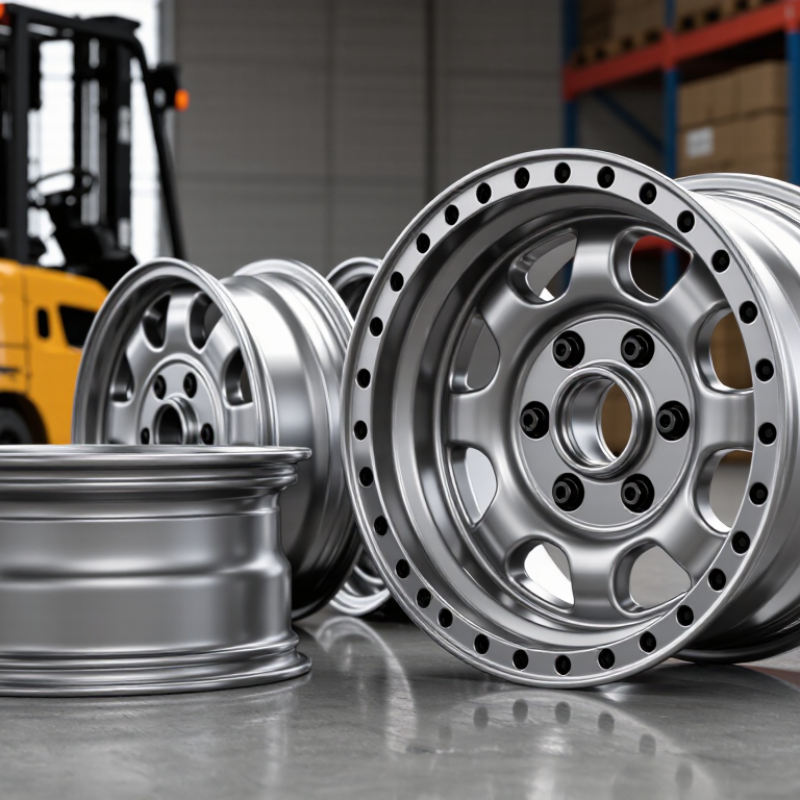
Forklift Wheel Rims: Types, Materials, and Core Functions
Forklift wheel rims support load transfer, tire seating, braking stability, and accurate steering. The World Industrial Truck Statistics report recorded more than two million industrial truck deliveries worldwide in 2023. That scale makes rim selection a maintenance issue, not merely a purchasing detail. Pressed-steel rims suit many warehouse forklifts and moderate-duty surfaces. Cast or reinforced steel rims handle harsher impacts, uneven yards, and heavier applications. Split rims can simplify tire service, but they demand strict assembly control. That assumption is too simple.
Material choice changes durability and safety. Carbon steel offers practical strength and repair familiarity. Higher-grade steel can resist deformation under repeated loading. Corrosion-resistant finishes help in humid warehouses, cold storage, and wash-down areas. Aluminum rims reduce unsprung mass, although they may not tolerate every impact pattern. The real answer depends on axle load, tire construction, speed, floor condition, and operating hours. Check the plate. Do not guess.
ISO 5053-1 provides terminology for industrial trucks, while OSHA guidance stresses inspection of tires, wheels, and rims before operation. The 2024 MHI Annual Industry Report also identified workforce shortages as a major supply-chain concern, making easy inspection increasingly valuable. Buyers should verify rim diameter, width, bolt pattern, offset, pilot diameter, and rated capacity against the truck manual. A visually clean rim can still hide fatigue around bolt holes. Measuring helps. So does reviewing failed parts rather than assuming the cheapest option is efficient. Reports count trucks, not rims; local duty cycles still decide the correct specification.
| Rim Type | Typical Material | Typical Forklift Use | Core Function | Main Advantages | Important Limitations | Buyer Checks |
|---|---|---|---|---|---|---|
| One-Piece Pneumatic Rim | Pressed or rolled carbon steel; corrosion-resistant coating may be applied | Outdoor forklifts and applications using pneumatic tires | Supports the tire and transfers drive, braking, and steering loads to the axle | Simple construction, good structural rigidity, fewer loose components, easier routine inspection | Tire removal generally requires dedicated tire-changing equipment; incorrect fitment can damage the bead | Check rim diameter, rim width, bolt pattern, center-bore size, offset, load rating, and tire compatibility |
| Two-Piece Split Rim | Heavy-gauge steel with a detachable side or lock section | Selected pneumatic-tire forklifts where field serviceability is important | Clamps and centers the tire assembly while allowing the rim to be separated for servicing | Can simplify tire removal and repair when the correct service procedure and equipment are used | Improper assembly, damaged retaining parts, or inflation without a safety cage can create serious hazards | Verify all locking components, mating surfaces, rim identification, and compliance with local safety rules |
| Multi-Piece Lock-Ring Rim | High-strength steel rim base, lock ring, and side ring | Heavy-duty pneumatic applications requiring demountable tire assemblies | Uses retaining rings to secure the tire and maintain the bead-seat assembly under load | Serviceable design and strong load-carrying capability when correctly matched and assembled | The highest service risk among common rim designs if rings are corroded, mismatched, or incorrectly seated | Confirm ring profile, rim width, component matching, corrosion condition, and approved inflation procedure |
| Cushion-Tire Wheel Disc | Machined or pressed steel wheel with a bonded solid rubber tire | Indoor warehouses, smooth concrete floors, and confined operating areas | Provides a compact rolling assembly without an inflatable air chamber | Low puncture risk, small turning radius, stable handling, and low overall operating height | Harder ride, limited ground clearance, and reduced suitability for rough outdoor surfaces | Check tire press-fit dimensions, wheel width, axle interface, floor conditions, and required clearance |
| Press-On Solid-Tire Wheel | Steel wheel core with a solid rubber tire pressed onto the wheel | High-utilization forklifts operating on paved indoor or outdoor surfaces | Combines a rigid wheel core with a puncture-resistant solid tire construction | Good stability, resistance to punctures, and consistent dimensions during normal service | Higher replacement cost than some pneumatic assemblies; mounting normally requires a hydraulic press | Confirm press-fit tolerance, wheel-core condition, tire compound, axle dimensions, and sidewall clearance |
| High-Strength Steel Rim | Formed high-strength low-alloy or carbon steel | Forklifts exposed to high loads, repeated impacts, or demanding shift cycles | Resists deformation while transmitting torque and vertical loads between the tire and hub | High stiffness, good fatigue resistance, and suitability for heavy-duty wheel assemblies | May weigh more and cost more than a standard-duty steel rim; strength does not compensate for incorrect sizing | Request material specification, weld quality records, rated capacity, dimensional inspection, and coating details |
| Corrosion-Resistant Coated Rim | Steel with powder coating, e-coating, zinc-based treatment, or another protective finish | Humid warehouses, food-related logistics areas, coastal regions, and wash-down environments | Protects the steel substrate from moisture and chemical exposure while retaining wheel strength | Improved surface durability and potentially longer service life in corrosive conditions | Coating cannot repair structural damage; chips, trapped moisture, and aggressive chemicals can still cause corrosion | Review coating thickness, salt-spray or corrosion-test data, chemical compatibility, and drainage design |
| Custom Hub-Mounted Rim | Engineered steel assembly, with optional reinforced center section | Specialized forklifts, non-standard axles, unusual clearances, or custom tire packages | Matches the exact hub, stud pattern, offset, tire envelope, and operating load of the truck | Enables precise fitment where standard dimensions cannot meet clearance or capacity requirements | Longer engineering and production lead times; errors in drawings can result in unsafe interference or overload | Supply axle drawings, hub measurements, tire data, vehicle capacity, offset limits, and inspection requirements |
It transfers load, supports the tire, and helps maintain stable braking and steering. Small errors can create vibration.
Pressed-steel rims often suit smooth indoor floors and moderate loads. They offer practical strength and controlled cost.
Choose reinforced or cast steel rims for rough yards, uneven concrete, frequent impacts, or heavier loads. Conditions matter.
No. Aluminum reduces unsprung weight, but repeated impacts may exceed its practical durability. Verify the application carefully.
Check diameter, width, bolt pattern, pilot diameter, offset, and rated capacity. Measure twice. Do not guess.
Not necessarily. Tire construction and rim design must match through verified compatibility. A similar appearance proves little.
Examine welds, flange shape, coating, material thickness, and visible runout. Use calipers for basic checks and a dial indicator when possible.
Include tooling, packaging, inland transport, freight, insurance, duties, inspection, and replacement costs. The lowest quote may not be cheapest.
Long transport can bend flanges or damage coated edges. Request protective packaging and inspect samples before large orders.
Request drawings, material certificates, inspection records, factory evidence, and batch traceability. Documents help, but samples reveal more. Recheck assumptions.
This guide to Forklift Wheel Rims explains how rim design, material selection, and construction affect forklift stability, tire performance, load handling, and service life. It covers common rim types and materials, then shows how to match rim dimensions, bolt patterns, offset, tire systems, and load ratings with different forklift models. Readers will also learn why accurate fitment and proper installation are essential for safe and reliable operation.
For global buyers, the article compares rim options by durability, corrosion resistance, maintenance needs, and total value rather than focusing only on purchase price. It also outlines key safety and quality considerations, including applicable technical standards, rated capacity, welding quality, surface finish, dimensional accuracy, and inspection records. The purchasing section provides practical guidance on evaluating suppliers, comparing costs, confirming specifications, reviewing samples, and arranging quality checks before shipment, helping buyers make informed decisions for demanding warehouse, industrial, and logistics environments.