In 2026, global buyers will examine more than payload capacity when selecting an Agricultural Tractor Trolley. They will compare field performance, unloading speed, maintenance access, and total ownership cost. A trolley that looks powerful may still disappoint on wet soil, narrow farm lanes, or uneven harvesting ground.
Dr. Scott Shearer, an agricultural machinery specialist at Ohio State University, emphasizes a practical principle: “A tractor is only as useful as the system around it.” This view matters when matching a trolley with tractor horsepower, hydraulic capacity, PTO requirements, and braking equipment. The best combination works as one unit.
This guide explores the leading Agricultural Tractor Trolley types for international buyers. It considers grain trolleys, dump trolleys, bale carriers, silage trailers, manure spreaders, and multi-purpose models. Each design serves a different job. Grain trolleys need stable unloading. Bale carriers need secure support. Silage trailers need strong floors and fast discharge.
Small details can decide the purchase. A low loading height saves repeated lifting. Wide tires reduce soil pressure. A reinforced drawbar handles rough turns. A washable floor reduces residue buildup. These features sound ordinary. They are not.
Buyers should also check local transport rules, service availability, spare-part supply, and operator training needs. Product labels can hide practical limitations. Sometimes, the most expensive model is not the safest choice. A careful comparison remains necessary, especially where terrain, climate, and farm size differ sharply.
This overview may not cover every regional preference. It should encourage closer questions before ordering.
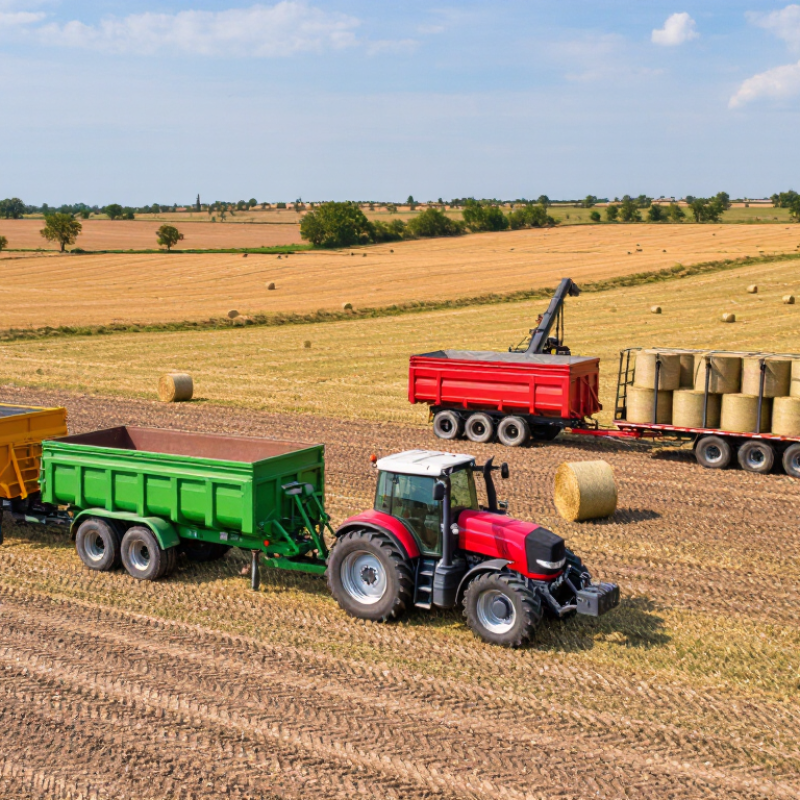
An agricultural tractor trolley is a towable load carrier designed to work behind a farm tractor. It transports crops, fertilizer, tools, feed, and other permitted materials across fields or farm roads. Unlike a self-powered vehicle, it receives pulling force from the tractor through a drawbar and hitch. Its main parts include a steel frame, axle, wheels, loading bed, and sometimes a hydraulic tipping system.
The trolley’s capacity must match the tractor’s safe towing ability, not only its engine power. Buyers should check gross load, empty weight, axle rating, tire size, ground clearance, and braking equipment. A wide bed may carry more volume, but it can become unstable on slopes. A low bed improves loading access. A tipping body can save labor during unloading, especially near storage areas. Specifications should also suit local road rules, field conditions, and available repair skills.
Real farm use often reveals details that brochures miss. Wet soil increases rolling resistance. Uneven tracks place heavy stress on the drawbar and wheel hubs. Operators should distribute the load evenly and inspect hitch pins, tires, lights, and hydraulic lines before work. Keep speed controlled.
A trolley is not a perfect solution. Some farms may need a lighter model, while others require stronger braking and suspension. Choosing only by advertised capacity can lead to poor handling, higher maintenance, or shortened service life. Careful field measurement and advice from qualified agricultural equipment technicians make the decision more reliable.
It is a towable carrier pulled behind a farm tractor. It can transport crops, fertilizer, tools, feed, and other permitted materials. It has a frame, axle, wheels, loading bed, and hitch. Some models include hydraulic tipping.
Match the loaded weight with the tractor’s safe towing ability. Do not rely on engine power alone. Check gross load, empty weight, axle rating, and tire strength. A two-ton model may suit a small farm. Larger farms may need five tons or more. More capacity is not always better.
Dump models help unload near storage buildings. Flatbeds suit tools, bags, and bulky equipment. Grain models usually have taller sides. Livestock models need suitable space and secure construction. Choose based on daily work, not appearance. A wider bed can become unstable on slopes.
Check reliable brakes, safety chains, reflective markings, and a stable axle layout. Inspect hitch pins, tires, lights, and hydraulic lines before every job. Keep the load balanced from side to side. Control speed on uneven tracks. Small checks matter.
Wet soil increases rolling resistance and may reduce control. Muddy fields require suitable tire width and ground clearance. Uneven tracks can stress the drawbar and wheel hubs. Slopes make tall or uneven loads more dangerous. A short field trial may reveal hidden problems.
Confirm horsepower, hitch category, hydraulic capacity, and drawbar height. Check any power take-off requirement. Make sure the connection does not force the hitch. The trolley should allow normal turning movement. Poor measurements can cause expensive frustration.
No. It can reduce unloading labor near barns or storage areas. However, it adds components that require inspection and maintenance. A simple flatbed may be enough for regular manual unloading. Consider work frequency, available repairs, and hydraulic capacity. Convenience has a cost.
Check loading height for safe manual handling. Confirm clear rear visibility during reversing. Distribute heavy material evenly across the bed. A tall side panel may hold more grain but raise instability. Brochures can miss this. Measure your actual loading area.
Request load ratings, test data, spare-part information, and service guidance. Ask about braking equipment and regional road requirements. Confirm available repair support and compatible replacement parts. Specifications may be incomplete. A technician’s advice is useful, though not perfect.
An Agricultural Tractor Trolley is a farm trailer designed to work with a tractor for transporting crops, soil, feed, tools, livestock supplies, and other materials. In 2026, these trolleys can be classified by load capacity, body structure, unloading method, axle design, and intended application. Common types include flatbed trolleys, side-panel trailers, tipper trolleys, livestock transport trolleys, and specialized models for harvesting or bulk material handling. Each type offers different advantages in terms of loading speed, stability, maneuverability, and operating efficiency.
Choosing the right trolley depends on the farm’s terrain, tractor power, transport distance, and daily workload. Buyers should compare rated capacity, frame strength, braking performance, tire suitability, hitch design, ground clearance, and unloading safety. Compatibility with the tractor is essential, including matching towing capacity, hydraulic systems, attachment points, and power requirements. Global buyers should also consider local road conditions, maintenance access, spare parts availability, operator protection, and applicable safety standards before making a purchase.